
What Happened
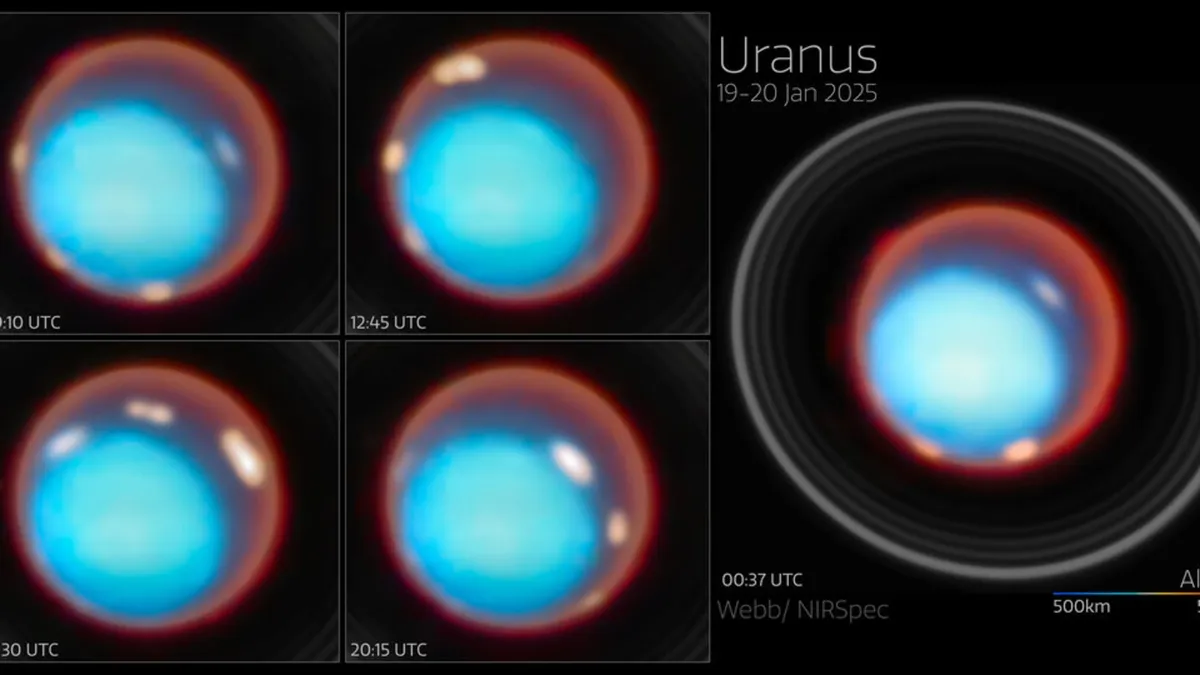
Scientists utilizing the James Webb Space Telescope (JWST) have made significant discoveries regarding Uranus and a historic supernova. In January 2025, JWST observed Uranus rotating for 15 hours, revealing bright auroral bands near the planet’s magnetic poles. This observation marks the first detailed mapping of Uranus’s upper atmosphere, shedding light on its unique magnetic field and auroras.
Additionally, a team from Northwestern University used JWST to identify a former star that exploded over 40 million years ago in a nearby galaxy. The light from this supernova reached Earth on June 29, 2025, leading to the discovery of the star’s ancestral form.
Why It Matters
The findings on Uranus are crucial for understanding the dynamics of ice giants and their atmospheres. Uranus’s magnetic field is notably tilted by 60 degrees, resulting in auroras that extend beyond its poles, a phenomenon not observed on Earth. This research could provide insights into how energy is distributed in the atmospheres of similar planets.
The identification of the historic supernova adds to our understanding of stellar evolution and the life cycles of stars. The JWST’s ability to capture detailed images of the supernova allows astronomers to trace the history of the star and its surrounding environment, enhancing our knowledge of cosmic events.
What’s Next
Future studies will likely focus on further analyzing the data collected from JWST to deepen our understanding of Uranus’s atmospheric dynamics and magnetic field. Researchers may also continue to explore the implications of the supernova discovery, potentially leading to new insights into the lifecycle of stars and the evolution of galaxies.