
What Happened
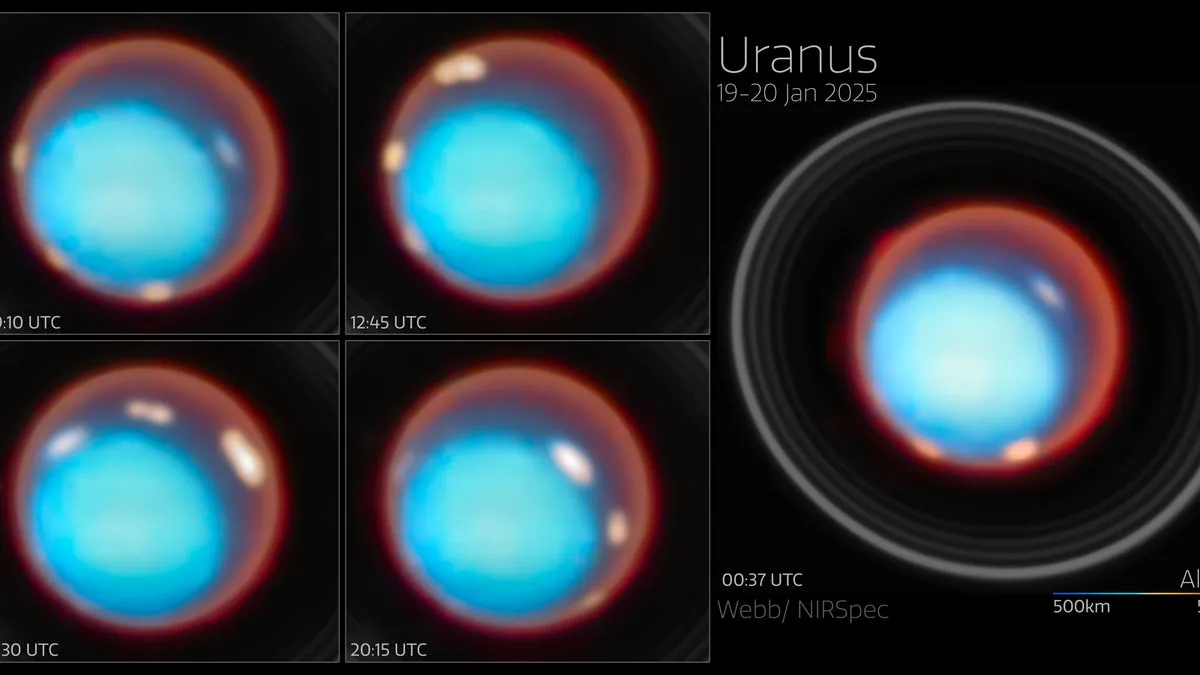
The James Webb Space Telescope (JWST) has recently provided groundbreaking insights into the ice giant Uranus and the progenitor star of a supernova. During a 15-hour observation period in late January 2025, JWST’s NIRSpec instrument captured multiple views of Uranus, revealing its auroras and upper atmospheric dynamics. Additionally, astronomers utilized JWST images to identify the star that preceded a supernova explosion in the galaxy NGC 1637, which occurred on June 29, 2025.
Why It Matters
Uranus, often overlooked in planetary studies, has unique characteristics that could help solve various planetary mysteries. Its extreme axial tilt and retrograde rotation provide insights into its formation and seasonal dynamics, which span 42 Earth years. The new data from JWST enhances our understanding of Uranus’s atmosphere, marking the first time its vertical structure has been mapped. Meanwhile, the identification of the progenitor star of a supernova offers valuable information about stellar evolution and the life cycles of massive stars, particularly in dusty environments where traditional telescopes like Hubble have limitations.
What’s Next
As researchers continue to analyze the data collected by JWST, further studies are expected to deepen our understanding of both Uranus and supernova phenomena. The telescope’s advanced imaging capabilities will likely lead to more discoveries about distant celestial bodies, enhancing our knowledge of the universe. Future observations may also focus on other planets and stellar events, as astronomers aim to unravel the complexities of planetary atmospheres and stellar life cycles.