
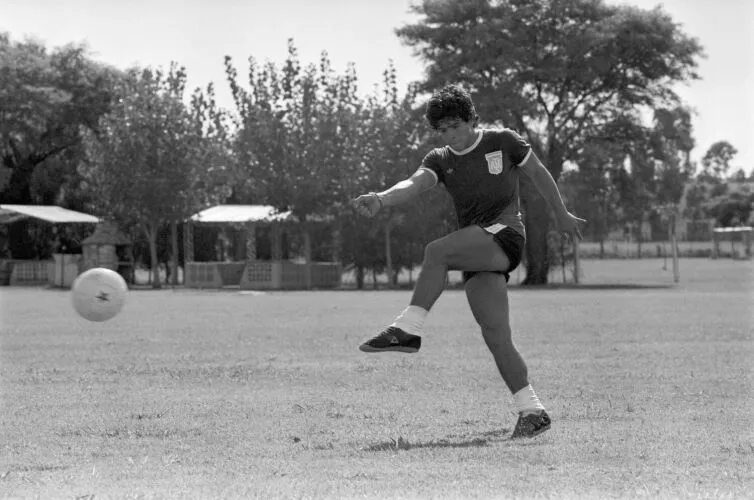
Diego Maradona, the legendary Argentine soccer player, recently found himself at the center of controversy after he made inflammatory comments regarding England’s victory over Colombia in a World Cup match. Following England’s penalty shootout win, Maradona referred to the outcome as a “monumental robbery,” prompting FIFA to express disappointment and emphasize the importance of fair play in the sport.
In a moment of emotional fervor, Maradona reflected on his remarks, stating, “Overcome by emotion in cheering for Colombia the other day I said a couple of things and I admit, some of them were unacceptable.” His comments were particularly pointed, as he singled out the American referee, Geiger, implying a bias in officiating that many fans and analysts have debated throughout the tournament.
Maradona’s history is marked by both brilliance on the field and controversy off it. Known for his extraordinary skill and infamous moments, such as the “Hand of God” goal in the 1986 World Cup, he has often been a polarizing figure. His recent comments echo a long-standing pattern of outspoken critiques regarding officiating and the integrity of the game, which have drawn both support and condemnation from fans and officials alike.
In a surprising twist, Maradona’s name has also surfaced in discussions about economic policy, particularly within the European Central Bank (ECB). The term “Maradona-style move” has been coined to describe a strategy of feinting in political maneuvering, suggesting that just as Maradona would deceive defenders on the pitch, central banks could similarly navigate economic challenges without making immediate changes to policy.
The ECB is reportedly considering this approach as it aims to signal an intention to tighten monetary policy without taking direct action. This metaphorical use of Maradona’s soccer prowess highlights the intersection of sports and economics, illustrating how his legacy transcends the soccer field.
Observers note that the ECB’s potential adoption of a “Maradona-style move” could be a strategic maneuver to manage market expectations amid economic uncertainties. As Manuel Abecasis pointed out, “It is virtually impossible for the Fed to tighten policy solely because of an oil shock,” indicating the complexities central banks face in today’s economic landscape.
As the dust settles from Maradona’s comments and the ECB’s deliberations, the soccer world and financial analysts alike are left to ponder the implications of his words. While FIFA’s disappointment reflects a commitment to fair play, Maradona’s enduring influence continues to spark discussions that extend beyond the realm of sports.
Details remain unconfirmed regarding the full impact of Maradona’s remarks on FIFA’s policies or the ECB’s potential strategies. However, his ability to provoke thought and discussion remains a testament to his complex legacy in both soccer and beyond.