
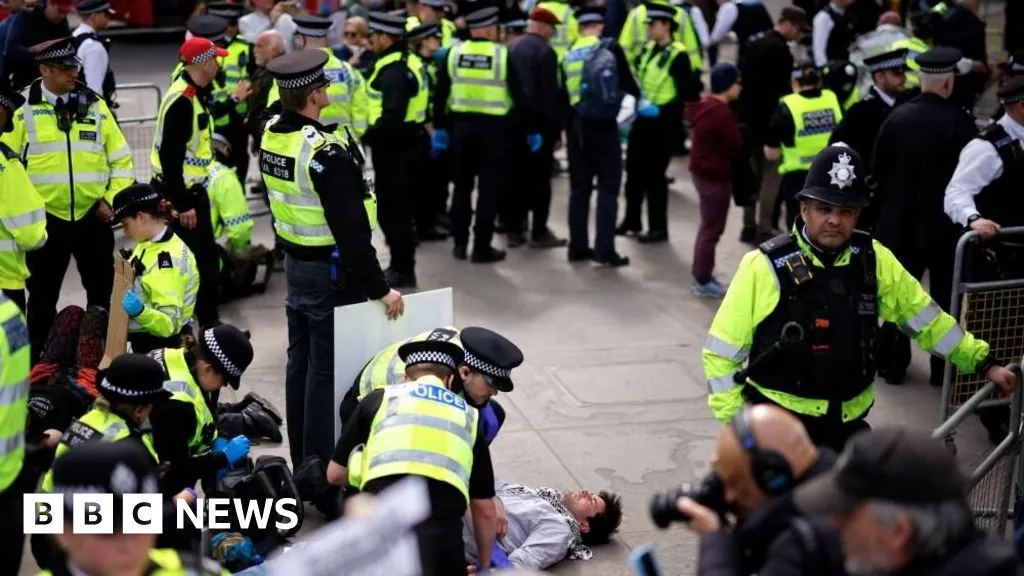
In the wake of escalating tensions surrounding civil rights and public demonstrations in the United Kingdom, a recent vigil in Trafalgar Square has become a focal point for both protestors and law enforcement. Prior to this event, many believed that the UK maintained a robust framework for free speech and peaceful assembly. However, the situation has dramatically shifted, revealing deep divisions between the government, police, and the public.
On April 11, 2026, police arrested 212 individuals during a mass vigil, which was attended by an estimated 1,500 people. The ages of those arrested ranged from 27 to 82, underscoring the broad demographic appeal of the protest. This event was organized in response to the UK government’s controversial decision to classify Palestine Action as a terrorist organization in July 2025, a move that many activists and legal experts deemed an infringement on civil liberties.
The decisive moment came when the High Court ruled on February 13, 2026, that the government’s proscription of Palestine Action was unlawful. This ruling was seen as a significant victory for civil rights advocates, yet it was met with a swift appeal from the UK government, scheduled for April 28 and 29. The tension between the government and civil society has only intensified, as evidenced by the police’s heavy-handed approach to the vigil.
In stark contrast to the previous expectation of peaceful dialogue and protest, the police’s actions have drawn widespread criticism. Qesser Zuhrah, a prominent activist, stated, “It just shows that the Met police, they don’t serve us, they don’t protect us, they work only to reinforce what the government wants.” This sentiment reflects a growing disillusionment with law enforcement’s role in mediating public dissent.
Meanwhile, across the Irish Sea, An Garda Siochana has also taken a hard stance against protesters, particularly those blocking critical infrastructure in response to rising fuel costs. The Commissioner of An Garda Siochana emphasized that illegal activities by fuel protesters are endangering the State, leading to a swift operation that cleared a blockade at the Whitegate oil refinery in approximately one hour. This parallel situation highlights a broader trend of increasing police enforcement against civil disobedience in both the UK and Ireland.
The immediate effects of these developments are profound. The mass arrests at the vigil have sparked outrage among demonstrators, with one unnamed protestor declaring, “I think Britain has now descended into a non-democratic situation and I think that is very dangerous for free speech.” This reflects a growing concern that the government’s actions may undermine the very democratic principles it seeks to uphold.
As the UK government prepares for its appeal against the High Court ruling, the implications of this crackdown on protests will likely resonate far beyond Trafalgar Square. Experts warn that the increasing militarization of police forces and the criminalization of dissent could lead to a chilling effect on free speech and public assembly. Justin Kelly, a spokesperson for the Defend Our Juries (DOJ) campaign, stated, “We will not tolerate this any longer,” signaling a potential escalation in public resistance to government policies.
In this evolving landscape, the role of the police is under scrutiny as never before. The events of April 11 have not only highlighted the tensions between the government and civil society but have also raised critical questions about the future of protest in the UK. As public sentiment shifts, the balance between maintaining order and respecting civil liberties will be tested in the coming months.