
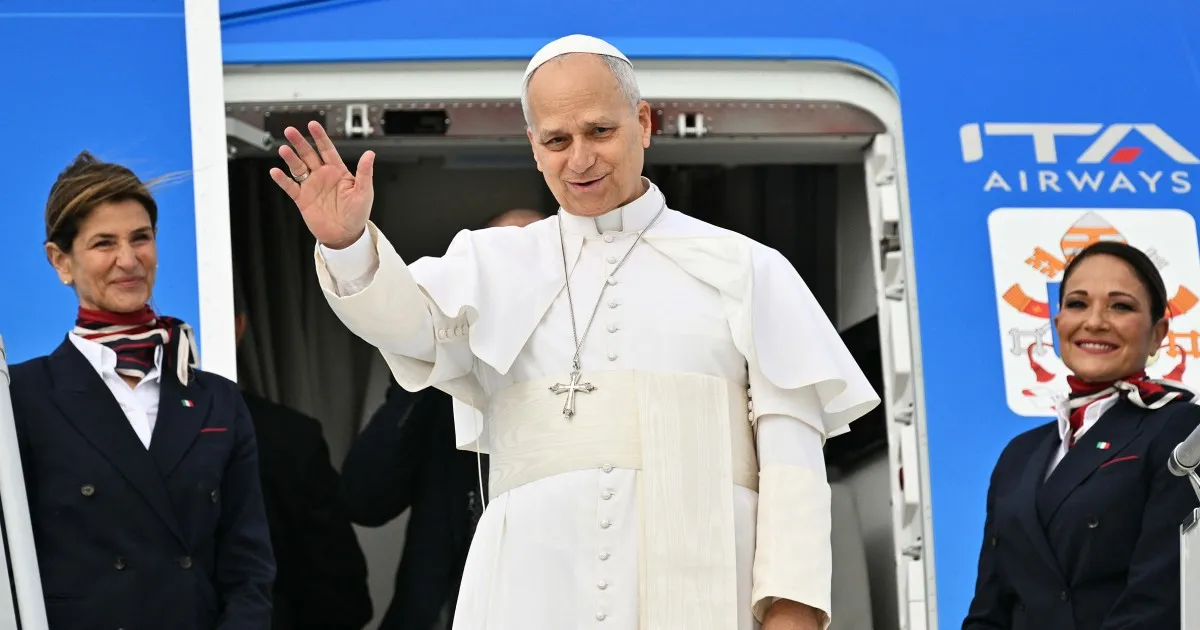
Before the recent developments, the relationship between Donald Trump and Pope Leo XIV was already strained, with tensions building over various political issues, including immigration policies and military actions. The Pope’s outspoken nature on moral and ethical grounds often clashed with the Trump administration’s hardline stance, leading to a growing divide.
The decisive moment came when Trump criticized Pope Leo XIV, labeling him as ‘weak on crime’ and ‘terrible for foreign policy.’ This public rebuke was met with an assertive response from the Pope, who stated, ‘I have no fear of the Trump administration, or speaking out loudly of the message of the gospel.’ Such exchanges have intensified the scrutiny on their relationship.
In a controversial move, Trump posted an AI-generated image of himself depicted as a Jesus-like figure, which sparked immediate backlash, particularly from conservative circles. The image was swiftly deleted following the uproar, highlighting the sensitivity surrounding religious imagery and the expectations of leadership.
Archbishop Paul Coakley rebuked Trump’s comments about the Pope, expressing his dismay: ‘I am disheartened that the President chose to write such disparaging words about the Holy Father.’ This sentiment reflects a broader concern among church leaders regarding Trump’s approach to religious figures and institutions.
Trump’s remarks have drawn criticism not only from church leaders but also from conservatives who typically align with him politically. The backlash indicates a potential fracture within his support base, as many feel that his comments undermine the sanctity of the papacy.
Pope Leo XIV is currently on an 11-day tour of four African nations, further emphasizing the global implications of this clash. His ability to address pressing issues in the international arena contrasts sharply with Trump’s more insular approach.
Trump’s assertion that he does not want a Pope who criticizes the President of the United States raises questions about the intersection of politics and religion. It suggests a desire for alignment rather than the traditional role of the Pope as a moral compass.
As this situation unfolds, the implications for both Trump and the Vatican are significant. Experts suggest that this clash could redefine the relationship between American politics and the Catholic Church, particularly as the 2026 elections approach.
In summary, the tension between Trump and Pope Leo XIV illustrates a broader cultural conflict, where political rhetoric increasingly intersects with religious identity. The consequences of this clash may resonate beyond their immediate exchanges, shaping public perception and political discourse.