
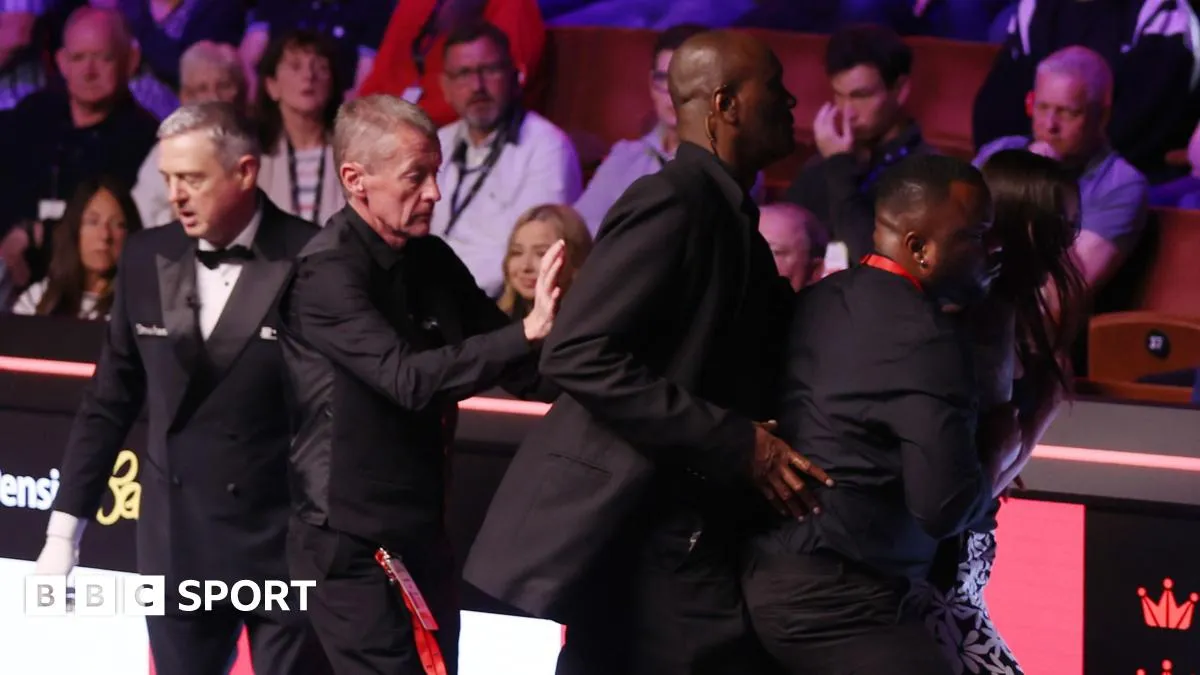
A female protestor disrupted the World Snooker Championship final on May 3, 2026, at the Crucible Theatre in Sheffield by jumping over a barrier and shouting about the BBC TV licence fee. This unexpected interruption occurred while Wu Yize led Shaun Murphy 67-31 in the frame, creating a moment of confusion for both players and spectators alike.
The decisive moment unfolded when the protestor’s actions halted the match, prompting immediate intervention from security personnel who swiftly removed her from the venue. This incident mirrored a similar disruption during the semi-final, where another spectator had shouted about unrelated matters concerning the Epstein files, raising questions about ongoing protests at this year’s championships.
As a result of this latest interruption, officials paused the match briefly before resuming play shortly after addressing the situation. The final was being broadcast live on BBC One, which likely contributed to heightened public interest in both the match and the protest itself.
According to sources, this incident has sparked conversations around issues related to public funding and media licensing fees in Britain. The protestor’s words—”Who f***ing pays their TV licence anyway?”—echoed sentiments shared by those critical of current broadcasting policies.
John Parrott, a former champion and commentator, addressed the incident post-match by stating, “Sorry for that disturbance, it’s all sorted.” This comment aimed to reassure viewers that despite the disruption, the event would continue as planned.
In terms of viewership, it is noteworthy that peak viewership for earlier rounds of this championship reached approximately 1.8 million during critical moments of play. With an arena capacity of 980 seats at the Crucible Theatre, such disruptions can have significant implications not only for live audiences but also for television ratings.
The ongoing discourse surrounding protests at sporting events raises questions about how athletes like Shaun Murphy and Wu Yize may be affected by external factors beyond their control. While their focus remains on competition, such incidents inevitably draw attention away from their performances.
This year’s World Championships have already faced multiple disruptions; thus far, they have highlighted broader societal issues while simultaneously challenging traditional norms within sports broadcasting.