
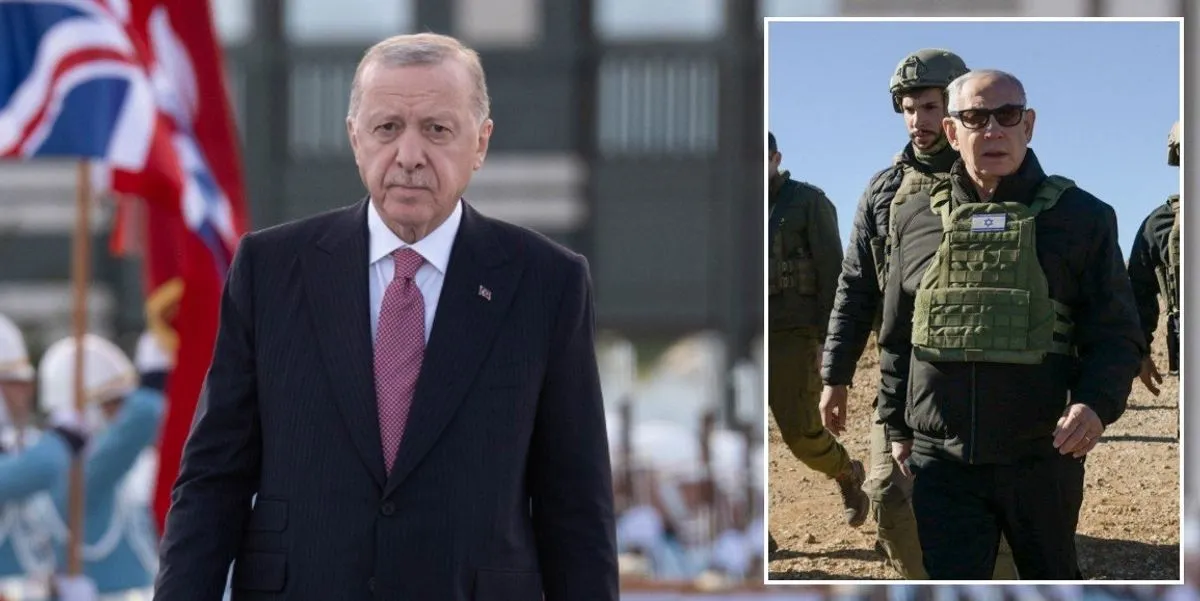
In a significant escalation of rhetoric, Turkish President Recep Tayyip Erdogan has threatened military action against Israel in response to its bombardment of Lebanon. This statement, made on April 12, 2026, comes amid heightened tensions in the region, particularly following Israel’s recent military operations that have displaced approximately 1.2 million Lebanese citizens.
Erdogan’s accusations against Israeli Prime Minister Benjamin Netanyahu were sharp, labeling him as “blinded by blood and hatred” and condemning Israeli military actions as “barbaric.” He further described these actions as part of a “blood-stained genocide network” targeting innocent civilians, including children and women. Erdogan’s fiery rhetoric underscores a growing sentiment in Turkey that positions the nation as a defender of Palestinian rights, a narrative that has been increasingly emphasized in recent years.
The Turkish government has also taken legal steps against Israeli officials. A Turkish court has indicted Netanyahu along with 35 other Israeli officials for their roles in the controversial stopping of the “Sumud” Gaza flotilla. Prosecutors are pursuing sentences totaling up to 4,596 years for those implicated in the case, reflecting the severity with which Turkey is approaching its grievances against Israel.
In a chilling remark, Erdogan stated, “There is nothing to prevent us from doing it,” referring to potential military action against Israel. This statement has raised alarms among international observers, as it signals a willingness to escalate military tensions in an already volatile region.
The backdrop to these threats includes a recent attack on the Israeli consulate in Istanbul, which resulted in injuries to two police officers and the death of the assailant. The attacker, identified as Yunus Emre Sarban, had previously faced charges related to ISIS but was acquitted. Following the consulate attack, Turkish authorities rounded up 273 known ISIS suspects, highlighting the complex security challenges Turkey faces as it navigates its internal and external conflicts.
Critics of Erdogan’s government have pointed out a troubling pattern: while the administration has cracked down on political dissent, it has been criticized for its lenient approach towards ISIS. This duality raises questions about the Turkish government’s priorities and its commitment to combating terrorism while also addressing international relations.
Reactions to Erdogan’s statements have been mixed. Israeli officials have dismissed his threats, with one commentator, Amichai Eliyahu, stating, “The hypocritical Erdogan doesn’t impress anyone with this current circus.” This sentiment reflects a broader skepticism regarding Erdogan’s intentions and capabilities in the face of Israel’s military might.
As tensions continue to rise, the international community watches closely. Erdogan’s government is under pressure to respond to the humanitarian crisis in Lebanon while also maintaining a strong stance against Israel. The coming days may reveal whether Erdogan’s threats will translate into action or remain as part of a broader narrative aimed at consolidating his position domestically and regionally.